Poverty May Pose a Greater Threat to Biodiversity Than Policy Gaps: ISB Research
- A new ISB-led study published in Nature Sustainability finds that poverty reduction and access to clean energy are critical for biodiversity conservation, with socio-economic factors often outweighing governance measures in protecting tropical forests.
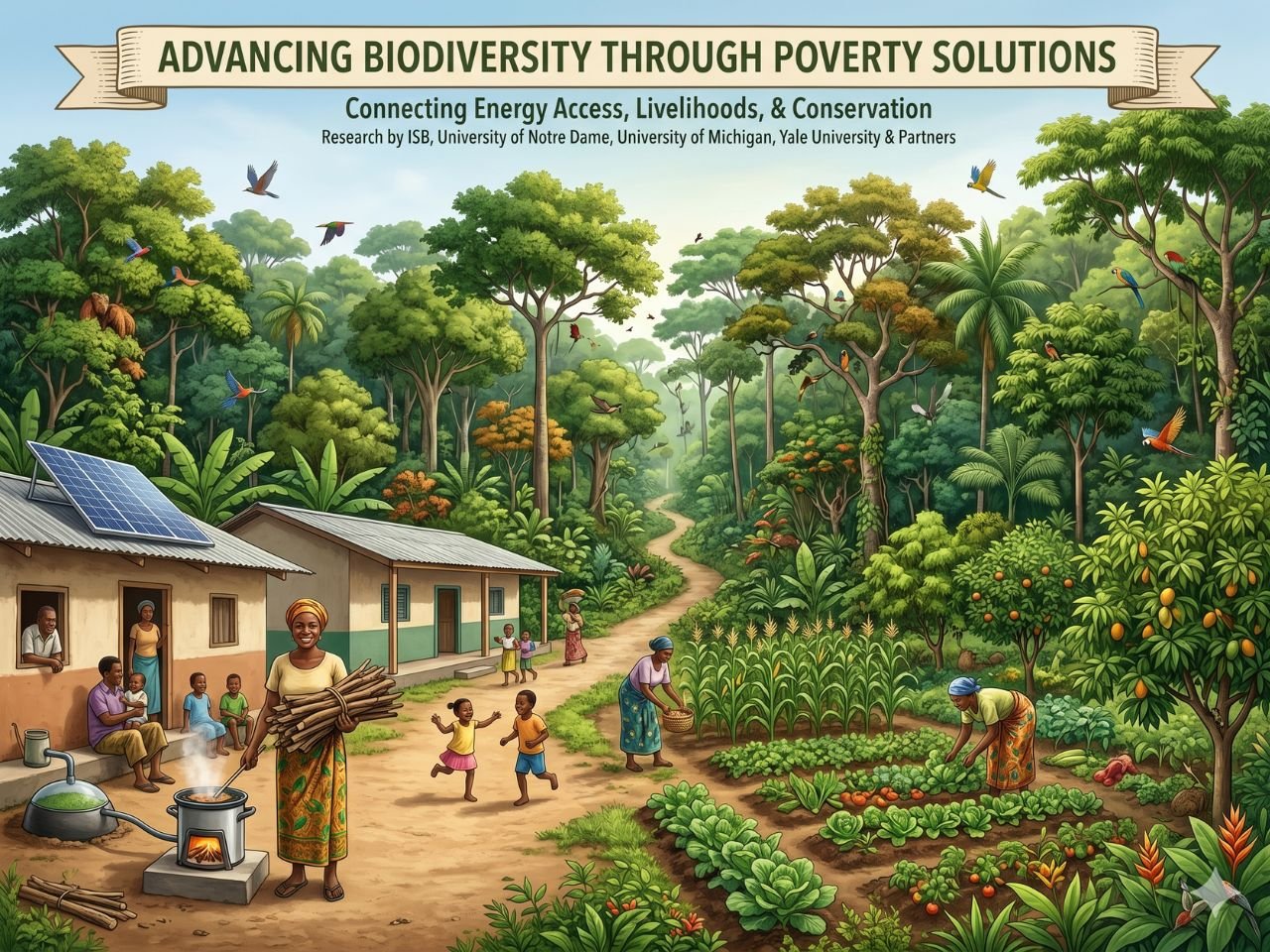
A new study led by researchers from the Indian School of Business (ISB) has highlighted the strong connection between poverty, energy access and biodiversity conservation, arguing that efforts to protect forests may fall short unless they also improve the living conditions of communities that depend on them. The findings have been published in the journal Nature Sustainability under the title Advancing Biodiversity Through Poverty Solutions.
The research examined more than 20 years of data collected from 322 community-managed forests spread across 15 countries in Asia, Africa and Latin America. Researchers analysed how factors such as poverty levels, dependence on forest resources, governance systems and land-use practices influence biodiversity in tropical forest landscapes.
The study was co-authored by Professor Ashwini Chhatre, Executive Director of the Bharti Institute of Public Policy at ISB, along with researchers from the University of Notre Dame, the University of Michigan, Yale University and other institutions.
Poverty and Energy Dependence Linked to Biodiversity Loss
According to the findings, forests located in areas with higher population densities and larger numbers of poor households experienced noticeable declines in tree species diversity. The impact was particularly evident among dominant tree species.
The research also found that communities heavily dependent on forests for fuelwood showed stronger links to biodiversity decline. This suggests that limited access to affordable and clean energy sources can place additional pressure on forest ecosystems over time.
Professor Chhatre said the findings challenge the long-standing view that environmental protection and human development are separate objectives. He noted that improving socio-economic conditions in forest-dependent regions could be as important for conservation as traditional regulatory measures.
The study also questioned some common assumptions about agriculture’s impact on biodiversity. Researchers found that communities relying more on subsistence farming often recorded higher levels of tree species richness. This suggests that localised and diversified agricultural systems may coexist with healthy forest ecosystems and, in some cases, support regeneration efforts.
The findings indicate that agricultural activity does not automatically translate into biodiversity loss, particularly when farming practices remain closely linked to local ecological conditions.
Governance Alone May Not Deliver Better Outcomes
Another key observation from the study was that governance structures by themselves may not be sufficient to improve biodiversity outcomes. Researchers found limited evidence that differences between community-managed and government-managed forests had a significant effect on tree species diversity. Similarly, livestock grazing did not show a statistically significant relationship with biodiversity changes across the study sites.
These results suggest that broader socio-economic drivers may play a larger role in shaping biodiversity trends than previously assumed.
The study comes at a time when countries and international organisations are working towards ambitious biodiversity protection and ecosystem restoration targets for 2030. The researchers argue that conservation strategies focused primarily on regulations, protected areas or governance reforms may not achieve desired outcomes unless they also address the root causes of environmental degradation.
The authors conclude that communities living in and around forests should be viewed as partners in conservation rather than pressures on ecosystems. They suggest that long-term biodiversity protection will depend on creating economic opportunities, improving energy security and enhancing the quality of life for forest-dependent populations alongside conventional conservation measures.