Uzbekistan Carbon-Credit Pilot Landed in India’s Cotton Belt
- ICAC's global regenerative-cotton carbon initiative has signed up India as its next testing ground — a financing model worth watching well beyond textiles.
The International Cotton Advisory Committee (ICAC), the global intergovernmental body for the cotton trade has signed on technology partner Merago Inc to oversee a formal monitoring-reporting-verification (MRV) certification and credit trading as the model scales to other cotton-producing countries.
The launched a carbon-credits initiative earlier this year combining regenerative agriculture, biochar application and a formal monitoring-reporting-verification (MRV) system. This system can generate certified carbon credits for cotton farmers.
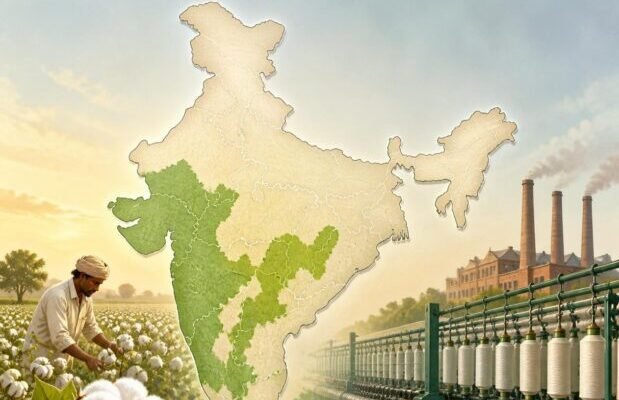
The pilot began in Uzbekistan; ICAC has now signed on technology partner Merago Inc to oversee MRV, certification and credit trading as the model scales to other cotton-producing countries. India, the world’s second-largest cotton producer at roughly 29.5 million bales a year across 13 million hectares, is the next major market for the rollout.
CITI brings Uzbekistan model to India
On 1 August, the Confederation of Indian Textile Industry (CITI) signed a memorandum of understanding with ICAC and Merago to bring the model to India, exchanged at the Cotton Corporation of India’s 56th Foundation Day in the presence of Union Textiles Minister Giriraj Singh.
Under the arrangement, ICAC provides agricultural expertise and technical support, Merago supplies the digital MRV and carbon-asset-management platform, and CITI’s Cotton Development and Research Association leads farmer engagement and project execution — including a district-level rollout already underway in Khargone, Madhya Pradesh, combining high-density planting with biochar and compost applications to raise both yields and soil carbon.
Why the financing architecture matters
The credits generated will be developed, verified and transferred in line with Article 6 of the Paris Agreement and India’s domestic carbon-market regulations — meaning India’s cotton belt becomes, alongside Uzbekistan, one of the first live tests of ICAC’s model for turning smallholder soil-carbon gains into internationally recognised, tradeable credits rather than domestic-only Carbon Credit Certificates.
That distinction matters financially: Article 6-compliant credits can, in principle, be sold to buyers anywhere in the world, not just within India’s own Carbon Credit Trading Scheme, which formally became mandatory for heavy industry — including textiles — from April 2026. A pilot phase is currently underway in Uzbekistan, where early results indicate strong potential for replication across cotton-producing countries.
The bigger financing question this answers
Cotton cultivation is water- and input-intensive, and India’s textile sector has faced mounting scrutiny — from EU sustainability due-diligence rules to buyer-side traceability demands — over the environmental footprint of its raw cotton.
A working, internationally credible mechanism for smallholder farmers to earn income directly from soil-carbon improvements addresses a financing gap that has dogged India’s broader sustainability agenda: schemes with real ecological upside for small farmers have often lacked a credible route to monetise that upside beyond government subsidy.
If the ICAC-CITI-Merago model proves durable at scale — and Uzbekistan’s early results are the only track record so far — it offers a template that could extend well past cotton, into any Indian smallholder crop where regenerative practices generate measurable, verifiable soil-carbon gains.