India’s EV Sales Surge 52% in Q2 2026, Crossing 8.37 Lakh Units
- India sold 837,453 electric vehicles in Q2 2026, registering 52.3% year-on-year growth, according to Ministry of Heavy Industries data, driven by strong demand for electric two- and three-wheelers.
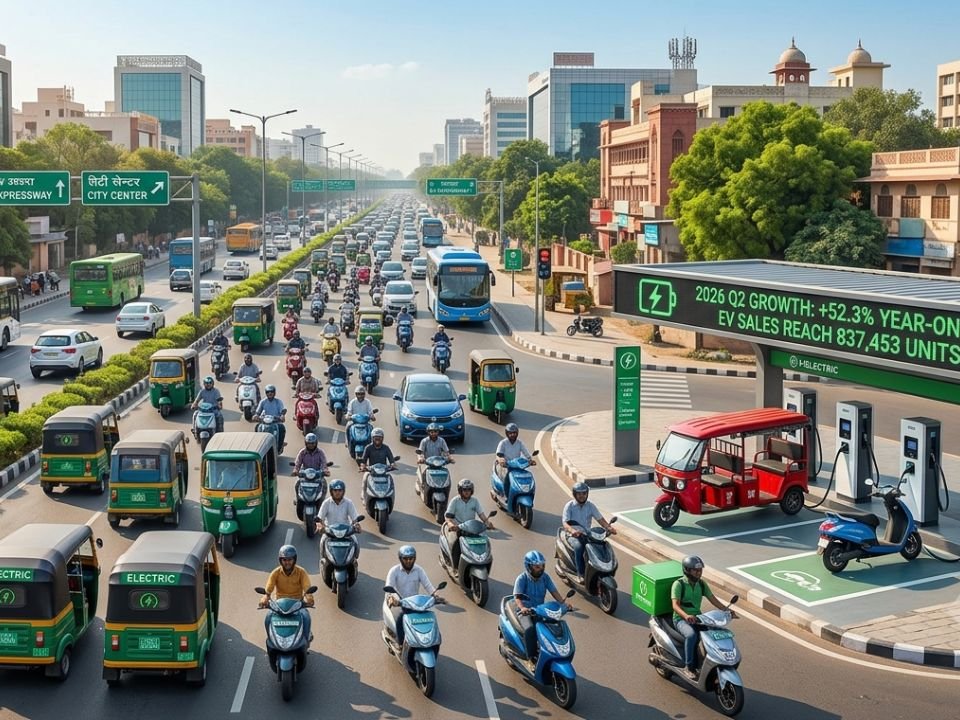
India’s electric vehicle (EV) market continued its rapid expansion during the second quarter of 2026, with sales rising 52.3 per cent year-on-year to 837,453 units, according to data from the Ministry of Heavy Industries (MHI). The figure compares with 549,900 EVs sold during the corresponding period in 2025, reflecting sustained consumer demand despite the absence of major new national purchase incentives.
The latest numbers suggest that EV adoption in India is increasingly being driven by market economics rather than policy support, with buyers continuing to shift towards electric mobility across multiple vehicle segments.
EV Market Records Strong Growth
India added nearly 288,000 more electric vehicles during the April-June 2026 period than it did a year earlier, underscoring the sector’s resilience amid evolving market conditions.
The growth comes after concerns in recent years that EV demand could slow as early adopters completed their purchases and government subsidies were gradually reduced. Instead, the latest quarterly figures indicate that consumer interest has remained strong, signalling that the market is entering a more mature phase of adoption.
With more than 9,000 electric vehicles being sold every day during the quarter, EVs are becoming an increasingly common feature of India’s transport landscape.
Two- and Three-Wheelers Continue to Lead Adoption
Unlike several developed markets where electric vehicle adoption has largely been driven by passenger cars, India’s transition continues to be dominated by two-wheelers (e2w) and three-wheelers (e3w).
Electric scooters have emerged as a popular choice for daily commuters, while electric auto-rickshaws and e-rickshaws have gained widespread acceptance among commercial operators due to their lower operating costs.
For many drivers, reduced fuel and maintenance expenses translate directly into improved household income, making electric mobility an economic decision rather than an environmental one. This cost advantage has played a major role in expanding EV adoption beyond early technology enthusiasts to mainstream consumers and commercial fleet operators.
Cleaner Urban Transport Offers Wider Benefits
The rapid adoption of electric two wheelers and electric three wheelers is also expected to contribute to improved air quality in India’s cities.
These vehicle categories account for a significant share of urban traffic and operate extensively in densely populated areas, where emissions from conventional internal combustion engines have a direct impact on public health.
Replacing petrol and diesel-powered vehicles with electric alternatives helps reduce tailpipe emissions in high-traffic corridors, residential neighbourhoods and last-mile transport routes. In addition to lowering local air pollution, electric vehicles also contribute to quieter urban environments by reducing traffic noise.
Infrastructure Challenges Remain
Despite the strong sales momentum, several challenges remain as India’s EV ecosystem expands.
Charging infrastructure continues to be unevenly distributed, particularly for apartment residents and urban consumers who lack dedicated parking or private charging facilities. Expanding access to reliable public and residential charging networks will be critical to supporting the next phase of EV adoption.
The environmental benefits of electric mobility also depend on the gradual decarbonisation of the power sector. While India’s electricity mix continues to include a substantial share of coal-fired generation, increasing renewable energy capacity is expected to improve the lifecycle emissions profile of EVs over time.
Battery recycling is emerging as another important priority. The first generation of batteries installed in EVs during the early 2020s is expected to begin reaching the end of its operational life before the close of this decade. As a result, investments in recycling facilities, second-life battery applications and extended producer responsibility (EPR) systems will become increasingly important.
Industry Enters a New Phase
The latest quarterly sales figures indicate that India’s electric mobility transition is moving beyond policy-led adoption and becoming increasingly consumer-driven.
With demand continuing to grow, attention is expected to shift towards strengthening the supporting ecosystem through expanded charging infrastructure, cleaner electricity generation, battery recycling capacity and improved grid readiness.
As quarterly EV sales continue to rise, these supporting systems will play an equally important role in ensuring that India’s electric mobility growth remains sustainable over the long term.