
Can India Sustain Ethanol Beyond Petrol Blending and Into Kitchens?
- A peer-reviewed study warned that India's ethanol programme already strains land, water, nitrogen and food security. The cooking-fuel plan doesn't resolve that tension. It deepens it, straight into the kitchen.
 Can India Sustain Ethanol Beyond Petrol Blending and Into Kitchens?
The Centre is preparing a policy framework to introduce ethanol as a household cooking fuel, aiming to absorb surplus distillery capacity and cut India’s LPG import bill.
It is a logical next step in a decade-long biofuel push — and it lands one week after a peer-reviewed study warned that India’s ethanol programme already strains land, water, nitrogen and food security. The cooking-fuel plan doesn’t resolve that tension. It deepens it, straight into the kitchen.
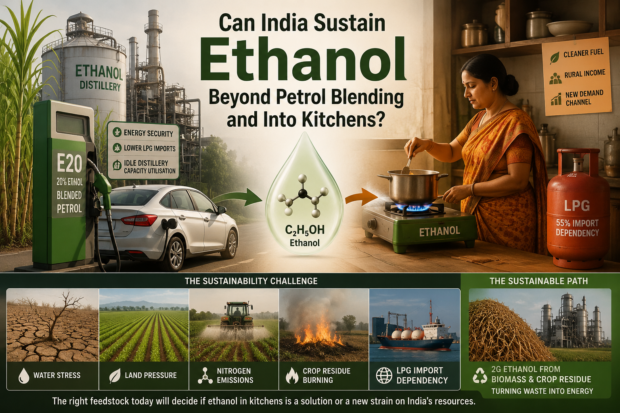
The logic on paper is neat. India imports around 55% of its LPG requirement, a dependency that geopolitical instability — from West Asia tensions to Strait of Hormuz shipping risk — makes increasingly uncomfortable, according to industry accounts of the government’s thinking.
Can India Sustain Its Ethanol Ambitions Beyond Petrol Blending?
Meanwhile, ethanol production capacity has expanded so fast in pursuit of the petrol-blending programme that roughly half of India’s installed distillery capacity now sits idle at times for want of feedstock or offtake.
A cooking-fuel mandate would absorb that spare capacity, displace imported LPG, and give sugar mills and grain-based distilleries a second demand channel beyond the blending pumps. On energy-security grounds alone, it is difficult to argue with.
But energy security is only one side of the ledger. Last week’s PLOS One study, from IIM Ahmedabad and Germany’s Potsdam Institute, modelled India’s biofuel trajectory to 2050 and found that leaning on land-intensive feedstocks drives mounting pressure on agricultural land, rising nitrogen emissions, and a deteriorating agricultural trade balance as crop output shifts from food and export markets toward fuel.
Producing a single litre of sugarcane ethanol consumes roughly 2,860 litres of water, by NITI Aayog’s own estimate — in a country where water stress already touches most districts. Every additional demand channel for ethanol, however sensible in isolation, adds to a feedstock call that the underlying agricultural system was never sized to meet without trade-offs.
A cooking-fuel mandate would not be a modest addition to that call. Petrol blending consumes ethanol by the tens of billions of litres annually at even 20% blending; a national cooking-fuel switch, if it followed LPG’s household reach, would summon a demand channel of comparable or greater scale, permanently, in every kitchen rather than every fuel tank.
Unlike blending, which competes for a slice of the transport fuel pool, cooking fuel competes directly with a necessity — for water, land and, crucially, for the same molecules currently earmarked to reduce crop residue burning and clean the air.
There is a version of this plan that squares the circle: if fed by second-generation ethanol — made from paddy straw and non-food biomass rather than sugarcane juice or grain — it becomes additive rather than extractive. India generates an estimated 120-160 million tonnes of surplus biomass annually, including the stubble that darkens Delhi’s winters. Diverting idle capacity toward that feedstock would turn a pollution liability into a genuine household fuel. The catch is that 2G ethanol plants under the PM JI-VAN scheme have struggled commercially, and idle first-generation capacity is, almost by definition, built for the food-crop route.
The Centre’s instinct — that idle capacity and an LPG import bill are both problems worth solving — is sound. But biofuel policy in India has a pattern of announcing the demand side before securing the sustainable supply side, and that pattern is precisely what last week’s study warned against repeating. A cooking-fuel mandate built on second-generation feedstock would be a genuine win for energy security, farm income and clean air simultaneously. One built on the easiest existing capacity would simply move the trade-offs from the fuel tank to the stove.