Nepal Disaster Exposes Climate Risks to India’s Himalayan Energy
- A glacial rock-ice avalanche on the Nepal-China border has killed at least 98 people and knocked out roughly 430 MW of hydropower and solar capacity — a preview of the risk India's own Himalayan clean-energy build-out faces.
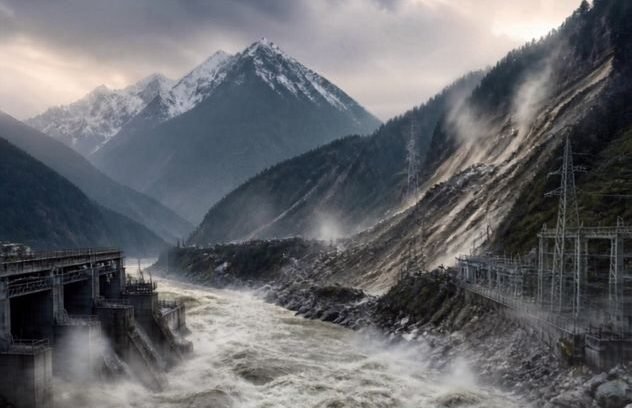
A rock-and-ice avalanche in Tibet triggered a cascading flash flood along the Nepal-China border on that has killed at least 98 people, left hundreds more missing. It also knocked out roughly 430 MW of hydropower and solar generation capacity — a stark illustration of how exposed Himalayan clean-energy infrastructure is to a warming, destabilising cryosphere.
According to Nepali officials and the Kathmandu-based International Centre for Integrated Mountain Development (ICIMOD), a magnitude 4.4 earthquake near the Nepal-Tibet border triggered a rock-ice avalanche that blocked the Lhende river in Tibet’s Gyirong county, causing it to burst and send a wall of water and debris down the Bhotekoshi and Trishuli rivers into Nepal’s Rasuwa and Nuwakot districts. The flood swept away at least 19 bridges and nearly 40 kilometres of road, and inundated the trading hub of Syabrubesi and the town of Trishuli Bazar.
Energy infrastructure among the casualties
The Nepal Electricity Authority said the disaster damaged six major hydropower and transmission facilities — Rasuwagadhi, Chilime, Trishuli 3A, the Trishuli 3B Hub 220 kV substation, Trishuli Hydropower Station, and Devighat Hydropower Station. This disrupted electricity supply across the affected region. It took around 430 MW Combined hydropower and solar generation capacity offline. South Korean officials said nine of their citizens working on a hydropower plant under construction in the area were among those reported missing.
Nepal’s government has asked both India and China for help with rescue operations, and has mobilised its army, armed police and helicopters. Among roughly 400 people reported missing, Nepal’s tourism board said 133 were Indian pilgrims travelling to Mount Kailash in Tibet, a site sacred to Hindus, alongside dozens of nationals from the US, Australia, Britain and Canada caught in the region during the Kailash trekking season.
A preview India’s own hydro build-out cannot ignore
ICIMOD’s preliminary assessment points to a glacial lake outburst-type event — the kind of cascading disaster that becomes more frequent as warming destabilises high-altitude ice and permafrost across the Himalayan arc.
The mechanism echoes India’s own 2021 Chamoli disaster in Uttarakhand, where a similar rock-and-ice avalanche destroyed under-construction hydropower stations and killed more than 200 workers. India’s clean-energy roadmap leans heavily on hydropower and hybrid capacity sited in geologically similar high-Himalayan terrain across Uttarakhand, Himachal Pradesh, Sikkim and Arunachal Pradesh.
The Nepal disaster is, in that sense, not simply a neighbouring country’s tragedy to note in passing. It is a live case study in a risk category India’s own energy planners and financiers have been slower to price than carbon risk or tariff risk: the physical vulnerability of clean-energy infrastructure built in a cryosphere that is changing faster than the design assumptions underneath most existing hydropower assets. As India expands hydro and pumped-storage capacity toward its 500 GW non-fossil target, the question the Bhotekoshi flood raises is not whether such an event could happen in the Indian Himalaya — Chamoli already answered that — but whether current site-selection and design-safety margins are keeping pace with how fast the risk itself is moving.