
India Launches First Hydrogen-Powered Train on Jind–Sonipat Route
- Each power car houses fuel cells, lithium iron phosphate batteries and hydrogen storage cylinders, delivering 1.2 MW of traction power apiece
- A combined 2.4 MW is capable of pushing the train to 110 km/h, though services will begin at 75 km/h.
- Onboard, hydrogen and oxygen combine in the fuel cells to generate electricity, with water vapour the only by-product.
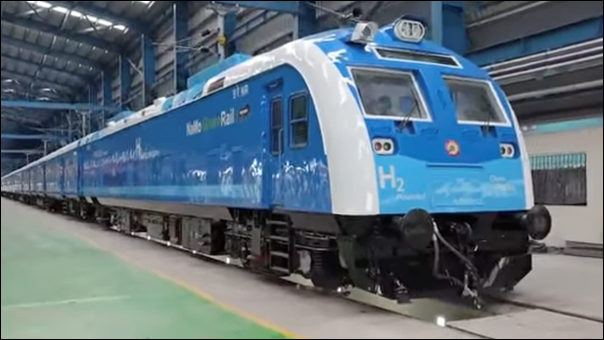
India’s long-promised hydrogen train is finally on the tracks. Prime Minister Narendra Modi has flagged off the country’s first hydrogen fuel cell-powered train, which will initially run on the 89-km Jind–Sonipat route in Haryana, connecting Jind Junction, Gohana Junction and Sonipat along with intermediate stations.
Germany got there first. India got their bigger — ten coaches and 2,600 passengers, against the two-to-four-coach regional trains running elsewhere. The trainset — designed, engineered and integrated in India — is a statement of scale as much as of intent. It comprises two hydrogen-powered cars and eight trailer coaches, carrying approximately 2,600 passengers.
Each power car houses fuel cells, lithium iron phosphate batteries and hydrogen storage cylinders, delivering 1.2 MW of traction power apiece — a combined 2.4 MW capable of pushing the train to 110 km/h, though services will begin at 75 km/h. Onboard, hydrogen and oxygen combine in the fuel cells to generate electricity, with water vapour the only by-product.
A Complete Hydrogen Ecosystem, Not Just a Train
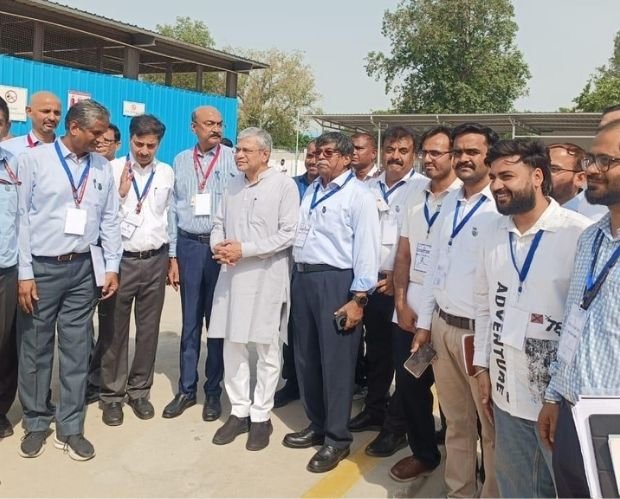
What separates this project from a photo-op is the infrastructure behind it. Indian Railways has built a full hydrogen ecosystem at Jind: green hydrogen is produced on site through electrolysis, compressed to 500 bar for dense storage, and dispensed at a regulated 350 bar through two independent dispensers, allowing both power cars to refuel simultaneously. The facility stores nearly 3,000 kg of hydrogen at a time — enough for regular operations — and has been cleared by the Petroleum and Explosives Safety Organisation. Multi-layer safety systems on the train detect hydrogen leaks, heat, flame and smoke.
The project is also a quiet showcase of Indian engineering depth. The Research Designs and Standards Organisation formulated the technical specifications and led design approval, Medha Servo Drives integrated the trainset, and the Integral Coach Factory shaped its theme and exterior.
Why It Matters Beyond Haryana
Hydrogen trains remain a global novelty. Germany was the first to run commercial hydrogen passenger services, while France, Italy, China and Japan are at pilot or limited-deployment stages — typically with two-to-four-coach regional trainsets. India’s ten-coach configuration makes this among the largest hydrogen passenger trains in service anywhere and a meaningful proof point for the National Green Hydrogen Mission’s search for anchor demand beyond refineries and fertiliser plants.
The societal case is equally compelling. Indian Railways is one of the world’s largest diesel consumers on its non-electrified sections, and hydrogen offers a path for routes where stringing overhead lines is uneconomical or, in the case of heritage lines, undesirable. The Railways has already indicated that the Kalka–Shimla heritage route could be next, leveraging the Jind experience.
For ordinary passengers on the Jind–Sonipat corridor, the change will be tangible in quieter, smoother, emission-free journeys through one of Haryana’s most air-quality-stressed belts. For the climate ledger, each diesel trainset displaced on non-electrified track removes a steady source of particulate and NOx emissions from communities that live along the line — a reminder that decarbonisation, done right, is also a public health intervention.
Caveats remain: the economics of green hydrogen versus straightforward electrification are unresolved, and one route does not make a revolution. But as a demonstration that India can design, build, fuel and safely operate hydrogen rail at scale — with the entire value chain onshore — the Jind–Sonipat train is the most consequential green mobility milestone of the year so far.