The Groundwater Law That Set North India’s Air on Fire
 Amid Pollution Woes, CAQM Reviews Progress Of Ethanol Blending Program
As this year’s paddy season heads toward harvest, the two crises of water and air turn out to share a single legislative root.
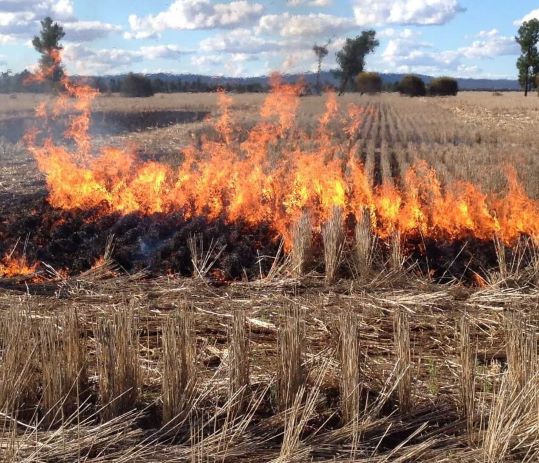
Every October, the same sequence repeats across Punjab and Haryana: paddy is harvested, fields are cleared by burning for the next wheat crop, and smoke settles over the Indo-Gangetic plain until Delhi’s air turns hazardous. The causes are treated most years as a farming problem. A lack of alternatives, weak enforcement, insufficient machinery subsidies. What gets far less attention is that the compressed timing of the burn, the specific reason there’s a narrow smoke-heavy window at all, traces to a water-conservation law passed with the opposite intention.
In 2009, Punjab passed the Preservation of Subsoil Water Act, pushing back the legally permitted start of paddy transplanting from May to mid-June, specifically to reduce groundwater extraction during the hottest, highest-evaporation months. It worked as intended on its own terms- it cut the water-intensive early-season irrigation that had been draining aquifers. But it also pushed the harvest later, from September into late October, compressing the gap between clearing paddy stubble and sowing wheat into just two to three weeks. Farmers already burn because it is the fastest way to clear a field; the 2009 law is why they now do it inside a shorter window than before, concentrated across the exact weeks that now produce Delhi’s worst air of the year.
This is the deeper problem: India’s agricultural and environmental policy frameworks were built as separate systems, so a law engineered to fix a water crisis was never evaluated against what it would do to air quality — and vice versa. Agriculture in India accounts for roughly 91% of the country’s freshwater use, which is precisely why the 2009 law targeted paddy irrigation in the first place. But nothing in that law, or in the environmental statutes meant to address stubble burning afterward, accounted for the fact that solving the water problem would tighten the air problem.
The pattern holds beyond Punjab. Government figures cite a 90% reduction in stubble-burning incidents since 2016, yet Delhi and neighbouring cities continue to register hazardous winter AQI readings above 400 most years, and this year’s Supreme Court hearings on the matter, in a case that itself dates back to a 1985 petition have already flagged both inadequate on-ground enforcement and false data from air-monitoring stations. Two explanations aren’t mutually exclusive: enforcement genuinely has improved on stubble fires specifically, while the structural timing problem the 2009 law created has never actually been addressed, only monitored more closely.
Behind the stubble burning is the decision to grow paddy and behind that, the overuse of water that resulted in falling groundwater levels, and a 2009 law that pushed the whole cycle later. For context, consider how paddy cultivation has touched a record 92% of cultivable land this year, made worse by a monsoon failure that will see record groundwater extraction as well in Punjab.
What an honest fix would require
None of this is an argument against the 2009 law’s water-conservation goal, which addressed a genuine and worsening groundwater crisis. It’s an argument that a water fix and an air fix, designed separately, can trade against each other in ways that show up as somebody else’s problem years later — in this case, as smoke over a capital city 1,000 kilometres from where the law was passed. A genuine fix would need the two systems read together: crop-diversification incentives that reduce paddy’s water and residue burden simultaneously, mechanised in-situ residue management scaled to match the compressed harvest window the water law created, or a serious look at whether the sowing-date mandate itself needs revisiting now that groundwater and air stress are both acute rather than trading one for the other.
As this year’s kharif season moves toward harvest, the question worth asking isn’t only whether stubble-burning enforcement holds up again this winter. It’s whether anyone in Punjab, Haryana or Delhi is measuring the water law and the air crisis as the same policy problem — because on the evidence of the last decade and a half, treating them as separate ones hasn’t solved either.