

5 Challenges To Reducing Dependence on LPG For The Hospitality Sector, And Solutions
Insights from Sandipan Mitra on reducing LPG dependence in hospitality sector, highlighting cost, infrastructure, workforce, and scalability challenges with practical transition solutions.
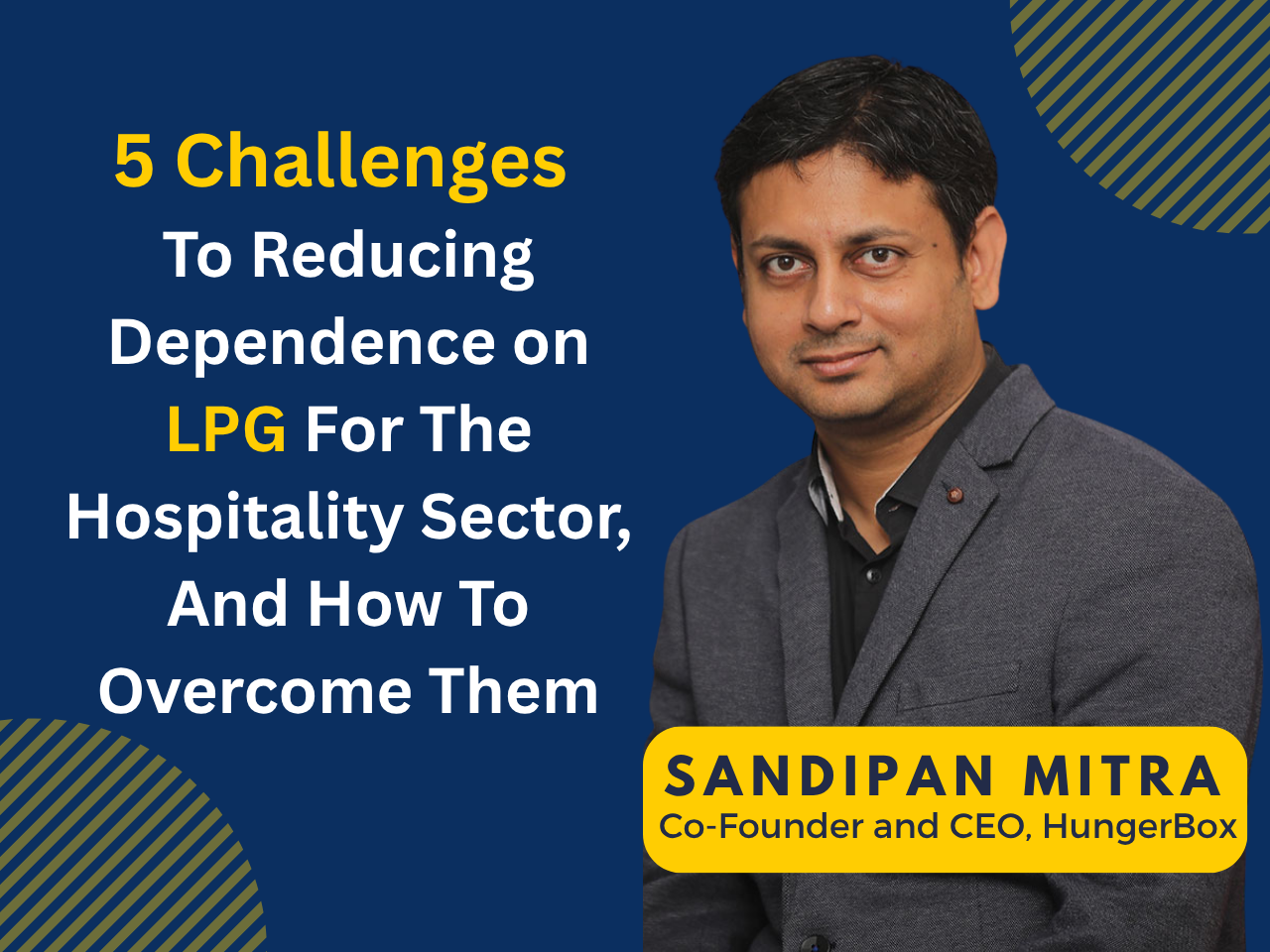 Sandipan Mitra, Co-Founder and CEO, HungerBox
The blue flame has been the default for Indian commercial kitchens for decades. It is reliable, familiar, and deeply embedded in how food is prepared at scale. So when the LPG supply disruption hit commercial kitchens across India in early 2026, the first instinct of most operators was not to reconsider their energy model. It was to wait for the gas to come back.
Across many institutional kitchens in India, operations are often built around a single primary energy source, LPG. In recent weeks, disruptions in supply have highlighted how heavily these systems depend on it and the operational challenges that can arise when that supply becomes uncertain. The situation has also brought into sharper focus several structural barriers that have historically slowed the shift toward alternative energy sources in institutional cooking, as well as the practical considerations that would need to be addressed for such a transition to become viable at scale.
1. The Upfront Cost of Transition
The most common reason commercial kitchens avoid switching to induction or electric cooking systems is the capital requirement. For operators managing tight margins, even a well-justified investment can feel prohibitive when the existing infrastructure still functions.
The path through this barrier is to treat the transition as phased infrastructure modernisation rather than a wholesale replacement decision. Hybrid kitchens, where induction handles base-load cooking while LPG is retained only for specialised applications, significantly reduce upfront costs while meaningfully cutting fuel exposure. This is the model institutional kitchens have been deploying with their vendor partners. The financial case for phased electrification is now considerably stronger than it was two years ago, and it will only improve as commercial gas prices continue their structural upward movement. Full transition does not need to precede the financial benefits.
2. Cooking Throughput at Institutional Scale
High-volume kitchens have long viewed induction cooking with scepticism, particularly around simultaneity: the ability to sustain full cooking load during peak service hours. This concern has a legitimate history. Earlier generations of commercial induction equipment had real limitations at scale.
That picture has changed substantially. High-power commercial induction systems and combination oven technology have matured to the point where a well-configured electric kitchen can match LPG throughput for the large majority of institutional menus. Where genuine throughput constraints remain, such as live counter formats that require open flame, the answer lies in menu engineering rather than a rejection of electrification. Kitchens that have redesigned their menus around electric cooking methods often report improved operational efficiency alongside reduced energy costs. The two outcomes are not in tension.
3. Power Infrastructure Readiness
This is the most structurally significant barrier, and the one most directly relevant to the energy sector. Transitioning a high-volume commercial kitchen to electric cooking requires substantially higher electrical load capacity than most legacy buildings were designed to support. A kitchen running on LPG may require 15 to 20 kW of electrical capacity. A fully electrified equivalent can require four to five times that figure.
For large institutional campuses, renewable energy enters the picture as an operational necessity rather than a sustainability gesture. Rooftop solar with battery storage, sized to support the kitchen load, transforms the economics of electrification substantially. The cost of captive solar generation has fallen to a level where, over a ten to fifteen-year horizon, it is meaningfully cheaper than grid supply for high-consumption facilities. Government schemes promoting solar adoption, combined with instruments such as Virtual Power Purchase Agreements, allow organisations to access clean and predictable power without bearing the full upfront cost of generation assets. For the energy sector, institutional food infrastructure represents a large and largely untapped demand pool for distributed renewable deployment. The current crisis is accelerating the conversation in a way that years of policy advocacy did not.
4. Workforce Inertia
This challenge receives less attention than it merits. Culinary teams trained on gas have developed strong intuitions around heat behaviour, timing, and cooking response that do not transfer automatically to induction surfaces. The result is institutional resistance from the people whose cooperation determines whether a transition actually works in practice.
The resolution is not persuasion alone. It requires structured retraining, supported by equipment suppliers and kitchen operations teams, that allows cooks to rebuild those intuitions on a new medium. Once kitchen teams spend meaningful time on well-configured commercial induction equipment, resistance reduces considerably. The cleaner working environment, the precision of temperature control, and the reduction in ambient heat within the kitchen tend to become genuine advantages in the eyes of the people working there every day.
5. The Financial Case, and the Structural Forces Now Reshaping It
Perhaps the most persistent barrier has been the belief that LPG, when subsidised and readily available, remains cheaper than its electric alternatives. That calculation has been shifting for some time. The events of 2026 have accelerated the shift significantly.
India consumes approximately 31 million tonnes of LPG annually while producing only 13 million tonnes domestically. That gap has widened consistently over the past decade and is not expected to narrow. Commercial allocations during the current disruption were cut to a fraction of normal offtake, while black-market prices for commercial cylinders surged to multiples of their regulated cost. Even when supply normalises, a sustained 15 to 20 percent increase in commercial gas prices is a structurally plausible outcome given India’s import exposure and the demonstrated fragility of Middle Eastern supply chains. At that level of price movement, the financial case for electrical alternatives becomes compelling even without accounting for operational resilience. When resilience is factored in, it becomes decisive.
The energy transition conversation in India has, understandably, focused most of its attention on transport and power generation. Industrial and institutional thermal demand has remained a quieter part of the debate. The LPG disruption of 2026 has changed that, at least for the food services sector.
In response to these evolving challenges, some institutional food service ecosystems have begun investing in infrastructure that supports a gradual shift away from single-source energy dependence. This includes investments in commercial-grade electric cooking technologies, distributed renewable energy systems, and kitchen designs that are better suited for diversified energy use. As these technologies mature and become more cost-competitive, the transition toward more resilient and flexible energy models in institutional kitchens is increasingly being seen as a practical possibility rather than a distant aspiration.
The hospitality sector does not face a choice between operational reliability and energy sustainability. For large-scale institutional food infrastructure, they have become the same objective. The question is no longer whether this transition will happen. It is whether operators will lead it or be forced into it.