Beyond SCADA: The operating system India’s CBG plants need
BioSarthi is developing an AI-powered operating system for Compressed Biogas (CBG) plants to improve operational efficiency, optimise production and reduce losses. By integrating plant data, laboratory results, maintenance records and operational workflows, BioSarthi transforms existing measurements into actionable insights, enabling faster decisions, consistent performance and scalable, data-driven plant management.
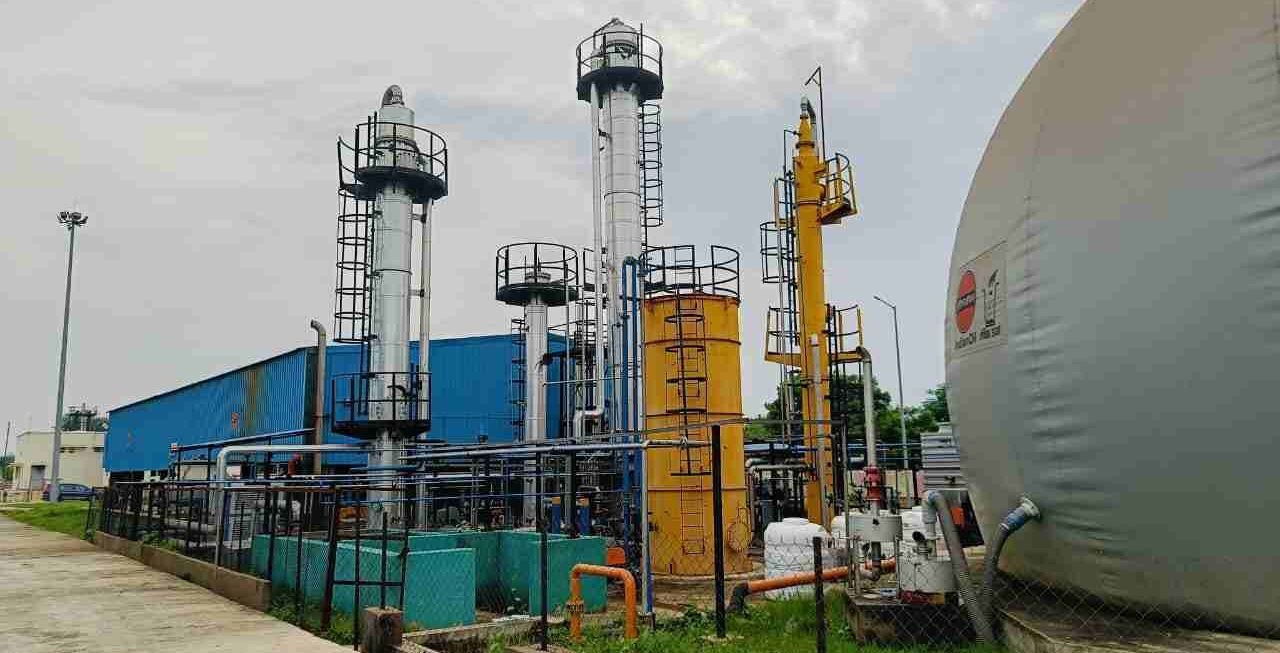
 The GOBARdhan Scheme has settled the questions that held back India’s Compressed Biogas (CBG) sector for most of the last decade. A ₹23,731 crore outlay, an administered price held over a minimum ten-year horizon, a blending obligation on city gas distribution, capital assistance and pipeline support: the case for building CBG plants is now made.
The case for operating them well is not. PNGRB has observed that many operational CBG plants run well below rated capacity, with utilisation at several plants between 20 and 60 per cent. With price and offtake now fixed for a decade, every point of that gap is an operating problem, and it shows up directly in the P&L.
The Gap is Not Measurement; It’s Inference
Most commercial CBG plants are already instrumented. SCADA records digester temperature, pressure, gas flow, balloon levels and gas quality. Laboratories track pH, VFA and alkalinity. Gate sheets log every tonne of feedstock. The data exists.
What it rarely does is tell the shift in-charge what to change, and when. Process data sits in the SCADA historian. Feedstock and dispatch records sit in registers and spreadsheets. Lab results sit in a notebook. Maintenance history sits with whoever last repaired the pump. Shift instructions travel over phone calls and chat groups. When output falls, connecting these records into an explanation depends on the judgement of a few experienced people, and that judgement does not transfer across shifts or sites.
That is the problem we are working on at BioSarthi.
What an operating system for a CBG plant does
We are building an AI-led CBG Operating System: one connected layer that sits above the plant’s control systems and brings process, feedstock, laboratory, maintenance, dispatch and financial data into a single operating record. Four principles shape it.
- Data true at the source: Field readings are verified against SCADA, and every sensor is documented and calibrated before its number reaches a dashboard. An inference built on an unverified reading is worse than none.
- A clear boundary with control: SCADA controls the plant. The operating system receives shift and hourly snapshots and alarm events, and never interferes with control logic.
- Built for how CBG actually works: Digesters are continuous biological reactors, not batch production lines. Acceptable pH depends on where a sample is drawn, not only on which parameter is measured. The system models these realities rather than forcing a CBG plant into a generic manufacturing template.
- Work, not just data: Checklists, shift handovers, SOP compliance, breakdown logs and maintenance history are captured in the same system, on the plant floor. The change in gas output and the action taken in response sit in one record.
The intelligence layer sits on top of this record. It reads plant data together with the plant’s own documentation (O&M manuals, process drawings, operating procedures), so a deviation is explained in the context of how that specific plant was designed to run.
From Data to Decision: Locating Gas Leak Across Five Acres
At our 100 TPD CBG plant in Gwalior, the plant’s gas balance stopped closing. The gas leaving the digesters no longer matched what was arriving at the ground balloon, and the gap persisted beyond the variation normally explained by temperature swings and gas drawn for upgradation.
A balance that does not close has two possible explanations: an instrument is reading wrong, or gas is escaping. Instruments were ruled out first. The pressure and flow sensors on the digesters and the balloon were checked, found to be operating correctly and confirmed to have been calibrated recently. That left a leak, somewhere on a site spread over five acres, across multiple digesters, gas headers and slurry and gas lines.
Rather than survey the entire site, the operating system analysed the previous 72 hours of plant data, a window long enough to cover several feeding cycles and full day-night temperature swings. It compared the behaviour of each digester against its own history and against the other digesters, and ranked Reactor 3 as the most probable source of the loss. The ground team was directed to begin there.
Within 120 minutes, the team located a major leak in the slurry overflow pipeline of Reactor 3. It was rectified within the next 30 minutes.
| 72 hours | Reactor 3 | 120 min | 30 min |
| Data window analysed | Ranked most probable source | Leak located | Leak rectified |
Based on our team’s experience of earlier leak surveys, locating it through a manual, site-wide inspection would have taken at least two days, with gas lost for every hour of the search. Beyond the lost production, that is methane, a potent greenhouse gas, escaping to the atmosphere.
None of this required a new sensor; every reading was already being recorded. What the system added was running the balance continuously, separating instrument error from real loss, and narrowing a five-acre search to a single reactor. Our aim is to make that routine rather than exceptional.
Talking Plants
The direction we are building toward is a plant that can answer for itself. An operator or plant head should be able to ask, in Hindi or English, why gas output fell yesterday, where the plant is losing gas, or whether a digester is trending towards acidification, and receive an answer grounded in that plant’s data and documentation, with the evidence attached.
We call these talking plants. They do not replace the operator’s judgement; they give it evidence, and they keep the reasoning on record so the next shift, and the next plant, can learn from it. The quality of those answers depends on the quality of the record beneath them, which is why we start with the record.
Sector Needs a Standard Stack
Refining, cement and speciality chemicals did not become reliable industries by installing instruments. They built the layer above them: common definitions, shared records and decision logic that converts a reading into an action. CBG has no equivalent yet. Every plant defines uptime and yield in its own way, keeps its own logs and develops its own practice. Little is comparable across sites, so little of what one plant learns reaches another.
Scaling CBG to the levels India has committed to cannot be done by multiplying bespoke operating cultures. Our operating system is therefore configured, not rewritten, for each plant: setpoints, capacities, feedstock sources and counterparties are held as master data, so the same system can serve plants of different sizes, feedstocks and technologies.
GOBARdhan has given the sector certainty on price, demand and capital. What remains is the discipline of running plants at the capacity they were financed for. That is where we believe AI earns its place: not as another dashboard, but as the operating layer that turns what a plant already measures into what its people do next.
The authors are co-founders of BioSarthi