Google Picks Four Indian Climate-AI Startups For Accelerator
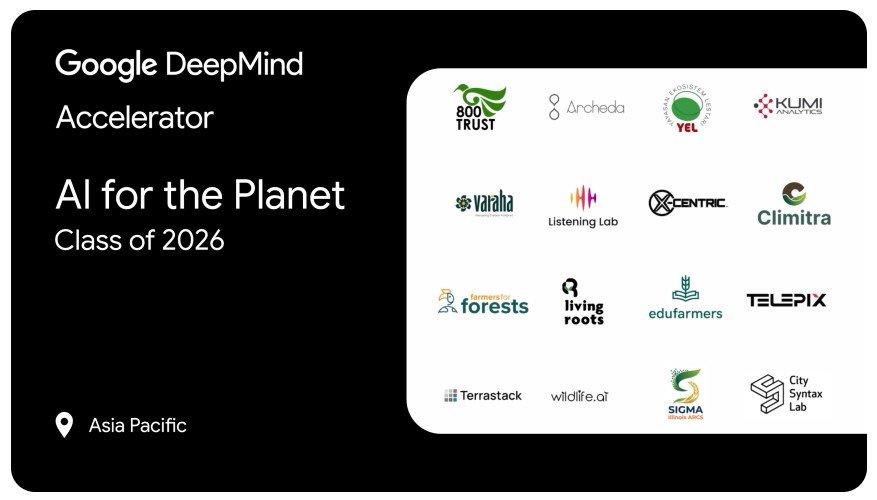
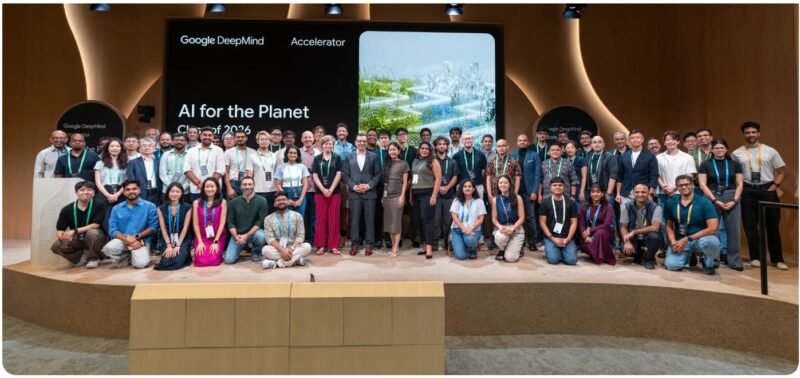
Google DeepMind opened its inaugural AI for the Planet Accelerator in Singapore this week, selecting 16 organisations from across Asia-Pacific to get three months of frontier-model access and mentorship for environmental work. This includes biodiversity monitoring, sustainable agriculture, carbon removal. Four of the sixteen are Indian. Read their one-line descriptions in Google’s own announcement back to back, and a common thread appears beneath the AI story: every one of them, in some fashion, is building toward the same financial instrument- carbon credits.
The four, and how each of them actually earns
Varaha Climate is the most direct case. It runs an AI-driven verification platform that uses remote sensing plus computer vision to check geo-tagged field photos for tampering and counts saplings or biochar volume. This allows smallholder farmers across India, Bangladesh, Nepal and Kenya turn regenerative practices into registry-grade carbon credits sold on international voluntary markets like Verra and Puro.earth. The company’s own pitch is explicit: farmers “often lack the technical capacity to prove their environmental impact,” and Varaha’s AI exists to close that proof gap so the credit can be issued at all.
Farmers for Forests runs a similar model one layer up the value chain: it fronts the cost of agroforestry for smallholders in Maharashtra, using drone-and-AI monitoring (its TreeLens platform) to verify tree survival and carbon sequestration, then pays farmers from a blend of philanthropy, government schemes and voluntary carbon revenue. On its own numbers, agroforestry plots run three times more biodiverse and sequester four times more carbon than conventional farms — but the payments that make farmers choose trees over crops still depend on a buyer purchasing the resulting credit.
Climitra Carbon works the industrial end of the same idea: geospatial AI (its GeoMitra platform) tracks invasive Prosopis juliflora shrub across Gujarat’s Kutch region, directing its conversion into biochar. That biochar splits two ways, sold as bio-coal to steelmakers as a drop-in substitute for coal in blast furnaces, and registered as carbon removal credits under methodologies like Isometric’s. Climitra is the partial exception here: it has a real second revenue line in industrial materials sales, not just credits, which matters for what follows. And as the recurrence of the invasive species in this case proves, a real need to track and ensure genuine removal.
Terrastack is the fourth, and the odd one out on paper — its own description is “plot-level land intelligence for smallholder farmers,” built to help them access formal credit, not carbon markets. But it sits on the same Google AI infrastructure (the ALU and AMED agricultural data APIs) that other ventures, like France-based CarbonFarm, use specifically to monitor flooded rice fields and issue carbon credits in Andhra Pradesh. Terrastack’s own product is credit-access and land records; the data layer underneath it is increasingly carbon-market plumbing regardless.
The amount of money needed to fuel this transition at scale simply cannot come from carbon markets alone. Government has to be part of it.
Good thing, or just the practical thing?
There’s a real question sitting underneath that pattern, and it’s worth naming without necessarily answering it. Carbon markets are, right now, close to the only mechanism that can move meaningful private capital toward hyper-distributed, hard-to-monitor environmental work. Be it a farmer in Kutch removing an invasive shrub, a smallholder in Maharashtra keeping trees standing instead of clearing land, a rice paddy in Andhra Pradesh switching to alternate wetting and drying. None of that shows up on any conventional balance sheet. The voluntary carbon market gives it one, and Morgan Stanley estimates that market growing from roughly $2 billion in 2020 to $250 billion by 2050. AI’s specific contribution — exactly what Google’s accelerator is betting on — is solving the verification problem that made this kind of small-scale, distributed climate action too expensive to monitor and audit until now.
But it’s also fair to ask whether four out of four Indian selections converging on the same revenue mechanism reflects genuine alignment between environmental good and financial incentive or simply reflects which mechanism happens to be fundable today, independent of whether it’s the right one long-term. Especially times with India’s own start of carbon markets trading this year. Even inside this cohort, the practitioners aren’t fully sold on carbon markets as a standalone answer: Farmers for Forests’ own leadership has said plainly that the money needed to fund this transition at scale “cannot come from carbon markets alone,” and points to government schemes as a necessary complement, not a backup. Climitra’s decision to build a second, non-credit revenue stream in industrial bio-coal sales reads the same way — a hedge against relying on one price-volatile, integrity-scrutinised market for the whole business case.
Whether that makes carbon credits the right long-term foundation for India’s AI-for-climate wave, or just the most practical scaffolding available while better mechanisms catch up, is the more interesting question this accelerator’s Indian cohort raises — one worth sitting with rather than resolving in a single announcement piece.