
E20 Achieved, What Next? ISMA’s Deepak Ballani on Ethanol Policy Gaps
- Deepak Ballani outlines India’s ethanol journey beyond E20, highlighting surplus capacity, policy gaps, export potential, and emerging applications like flex fuel, diesel blending, and ethanol cooking as the next phase of growth.
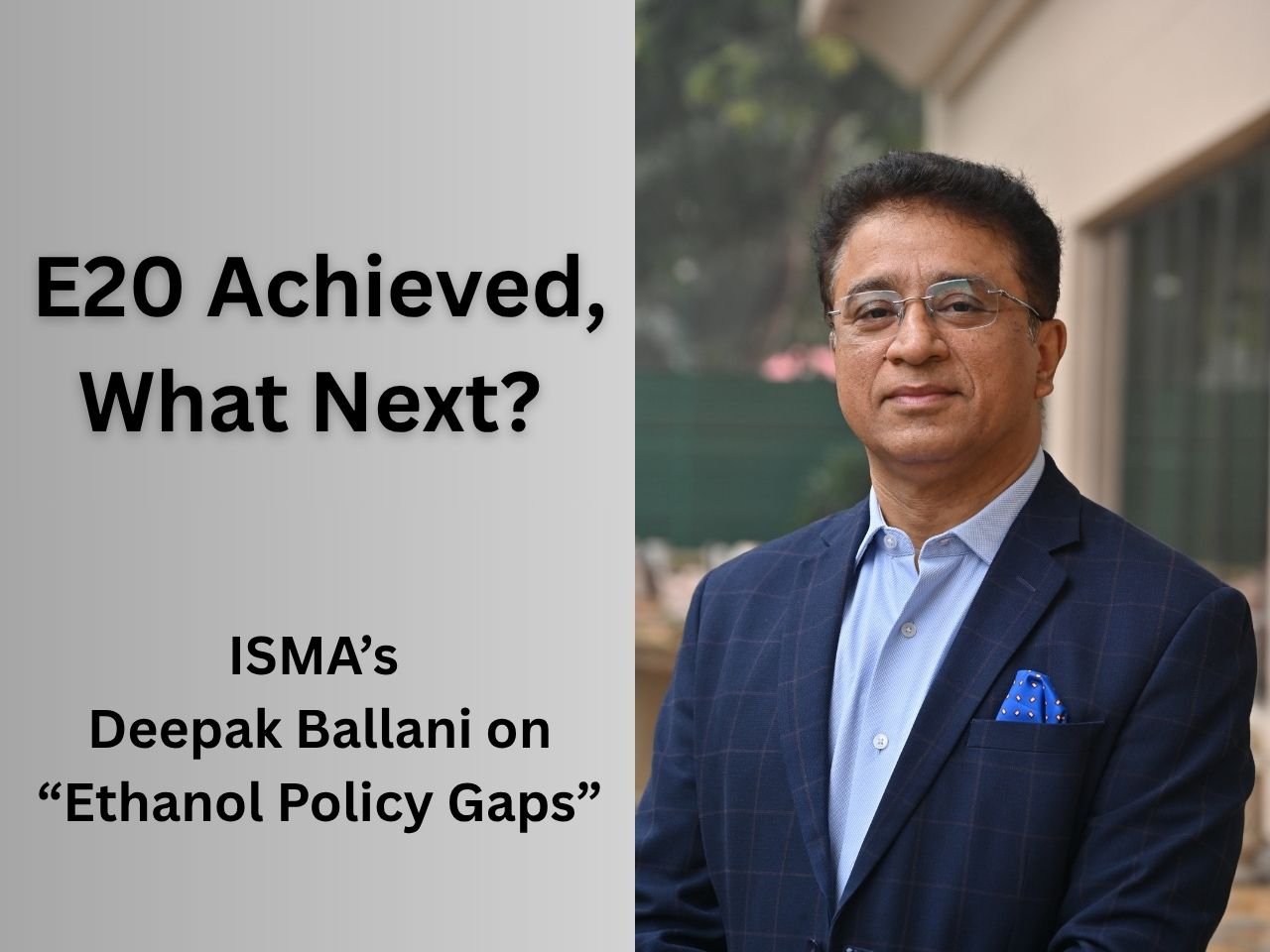
This is a transcript of an interview with Deepak Ballani, DG, ISMA, regarding a policy proposal of strategic importance concerning the adoption of ethanol-based cooking solutions as a complementary clean fuel within India’s cooking energy framework.
How does the current situation in West Asia reshape India’s energy planning, and does it strengthen the case for the biofuel sector?
The West Asia crisis has highlighted the fragility of India’s dependence on imported fuel, with energy security closely tied to global supply chains.
Ethanol blending has already strengthened resilience, with the E20 programme reducing crude imports by around 4.5 crore barrels. At the same time, global interest in ethanol mandates is rising as countries look to cut import dependence.
However, the focus must now shift beyond E20. Despite achieving the target ahead of schedule, long-term planning has lagged. The sector is now facing overcapacity, with production of 2000–2400 crore litres against demand of around 1100 crore litres.
Going forward, expanding alternative applications—such as ethanol cooking, diesel blending, and other uses—will be key to balancing supply and sustaining growth.
India achieved its ethanol targets well ahead of schedule, reaching 2030 goals as early as 2026. What enabled such rapid capacity expansion across capital, land, and infrastructure—and is there a broader lesson in this success?
This was clearly a result of policy push, not coincidence. The government advanced targets early and, between 2018–20, actively drove capacity creation through a clear roadmap, interest subvention, and strong coordination with industry.
The sugar sector was encouraged to integrate distilleries, enabling diversion of molasses and sugarcane juice. At the same time, assured 100% offtake and administered pricing created a stable investment environment. Grain-based distilleries were also supported through long-term agreements, expanding the supply base.
Together, these measures enabled rapid capacity expansion and early achievement of E20. However, this also led to overcapacity. Offers reached nearly 1900 crore litres last year, while allocations were much lower, leaving about 50% capacity idle.
At the same time, pricing has not kept pace with rising feedstock costs—especially sugarcane, which accounts for around 75% of production cost. Despite increasing FRP and state prices, ethanol prices have remained unchanged for three years.
This has created pressure on both allocation and pricing, making policy correction critical for the sector’s stability.
Why was there earlier resistance to using molasses for ethanol, and what is driving the current shift towards maize as a key feedstock?
Initially, ethanol production relied on C-heavy molasses, which yields limited output. The concern earlier was that diverting sugar could affect domestic supply. However, with consistent surplus production over the past decade, the government prioritised domestic demand first, followed by ethanol diversion and then exports.
This led to allowing B-heavy molasses and sugarcane juice for ethanol, with annual limits based on production estimates.
The shift to maize emerged in December 2023, when concerns over potential sugar shortages led to temporary restrictions on sugarcane-based feedstock. To sustain blending targets, maize ethanol was incentivised with an additional ₹6 per litre.
However, the expected sugar shortfall did not occur, and stocks rose to around 80 lakh tonnes, putting pressure on domestic prices.
At the same time, maize promotion had unintended consequences. Instead of replacing paddy, it displaced crops like pulses and soybean, increasing imports. Despite an MSP of ₹24, market prices remained at ₹16–17, making it less viable for farmers.
As a result, many farmers are now shifting back to traditional crops, and the government is working towards a more balanced feedstock strategy.
With CBG underperforming so far due to feedstock challenges, do you see it competing with ethanol in the future—and what is the way forward?
CBG and ethanol are not competing fuels, as India’s energy demand requires multiple pathways, including EVs, ethanol, CBG, and green hydrogen. While CBG has strong potential, its progress has been slower than expected despite ambitious targets for 2025.
From the industry’s perspective, feedstock like press mud and spent wash is available, but the key bottleneck is the offtake of by-products such as FOM and LFOM, along with restrictions on inter-state movement.
Project viability is another concern, with ROI currently at 7–8 years—too long to attract investment. Bringing this down to 3–5 years through policy support will be crucial. Including these by-products under the fertiliser ministry’s MDA scheme could also improve viability.
While schemes like SATAT have provided a base, additional financial support under new frameworks could accelerate growth. With the right policy interventions, the sector can see stronger industry participation.
How competitive is India in ethanol exports, and why hasn’t it emerged as a major export segment yet?
India’s ethanol export competitiveness is constrained by its cost structure, as feedstock accounts for nearly 75% of production costs. With some of the highest sugarcane prices globally, domestic ethanol is more expensive than alternatives like US grain-based ethanol, which benefits from higher yields and less regulation.
As a result, India lacks strong international price parity, reflected in policy as well—since 2018, ethanol for fuel blending has been placed under the restricted category to prioritise domestic use.
However, the global outlook is changing. Geopolitical uncertainties, including the West Asia crisis, are driving countries to consider ethanol mandates, which could increase global demand and prices.
With surplus capacity, the industry has suggested allowing calibrated exports—permitting them only after domestic requirements are met, with annual quotas set by DGFT. This approach can balance domestic priorities while tapping emerging global opportunities.
Where does India stand in ethanol technology today—particularly in comparison to advancements like 2G and beyond—and is there a significant gap we need to bridge?
India is very strong in first-generation (1G) ethanol and is among the most efficient producers globally.
However, in second-generation (2G) ethanol—based on agro-waste such as bagasse and crop residue—the ecosystem is still limited. At present, only a few projects, such as IOCL’s Panipat plant, are operational, and even these face technological and operational challenges. Another plant in Assam using bamboo is under development, but its performance remains to be seen.
While 2G ethanol has significant potential and the technology itself is reasonably mature, the key challenges in India are related to feedstock aggregation and economics. Agricultural residue is seasonal and dispersed, making year-round supply difficult, whereas plants require continuous operation.
Cost is another major constraint. Production costs for 2G ethanol are significantly higher—around ₹120 per litre compared to ₹70 for 1G ethanol. At the same time, there is no clear pricing or procurement mechanism for 2G ethanol, which limits commercial viability. As a result, investment remains constrained.
The industry is waiting for policy clarity and pricing support, while large-scale deployment depends on that very investment—creating a classic chicken-and-egg situation. Both policy support and industry participation will need to progress together to scale up 2G ethanol in India.
How vulnerable is the ethanol sector to a weak monsoon, and are these water-related risks being adequately addressed?
Monsoon variability is always a factor for the industry, particularly in rain-fed states like Maharashtra and Karnataka. In contrast, regions such as Uttar Pradesh are less dependent on rainfall due to stronger irrigation systems.
To mitigate these risks, the industry is actively investing in crop resilience. New sugarcane varieties with better drought resistance, pest tolerance, higher yields, and improved recovery rates are being developed. ISMA itself is working on nearly 28 varieties, with a few showing strong potential to significantly improve productivity.
At the same time, the adoption of micro-irrigation is increasing, supported by government subsidies, which is reducing dependence on monsoons.
In recent years, even with fluctuations in rainfall, sugar production has remained above domestic consumption, allowing consistent diversion to ethanol.
Therefore, while a weak monsoon may have some marginal impact, it is unlikely to disrupt the industry structurally or affect ethanol diversion in a significant way.
What alternative use cases for ethanol could significantly drive future demand and volume uptake?
Beyond increasing petrol blending, flex-fuel adoption could be a major demand driver. Countries like Brazil have shown that flex-fuel vehicles—capable of running on blends from E0 to E100—can significantly expand ethanol use.
If India moves towards E85 or E100, it could boost consumption, though differential pricing will be needed to offset lower fuel efficiency and ensure consumer acceptance.
Diesel blending is another avenue. Despite technical challenges like flashpoint, past trials—such as KSRTC’s ethanol-diesel buses—have shown promise. With surplus capacity and ongoing R&D, this could be a breakthrough segment.
Ethanol-based cooking is also an emerging use case. Successful deployment in countries like Kenya suggests potential in India, especially for Ujjwala beneficiaries.
With a proposed policy framework already in place, this segment could become a meaningful new demand driver with the right regulatory support.
How self-reliant is India’s ethanol manufacturing ecosystem today, and what is the current scale of the sector in terms of investment, companies, revenue, and employment?
India’s ethanol manufacturing ecosystem is now fully indigenous. Machinery, commissioning expertise, and plant development are all handled domestically, with Indian companies leading capacity creation.
In terms of scale, the sugar industry alone has invested around ₹40,000–45,000 crore to build ethanol capacity of approximately 900 crore litres, largely integrated within existing sugar mills.
While the exact number of companies is difficult to quantify, the sector supports an estimated workforce of 3–4 lakh people. Overall, it represents a significant and rapidly expanding industrial ecosystem.
What are the biggest misconceptions or perception gaps around ethanol that you encounter?
One of the biggest misconceptions relates to engine performance. Despite negative narratives—particularly on social media—there is no evidence that ethanol blending causes engine damage. Testing agencies like ARAI have clearly established that ethanol-blended fuels are safe for engines.
However, misinformation tends to spread quickly, and once it gains traction, it becomes difficult to counter, even with scientific evidence.
There is a minor impact on mileage, as ethanol has about 25% lower calorific value than petrol. But at E20 levels, the actual drop in efficiency is limited to around 2% to 5%.
This is further offset by the use of higher-octane fuels such as RON 95, which improve engine performance, reduce knocking, and enhance efficiency.
Overall, there are no major concerns with ethanol usage. For higher blends like E85 or E100, however, appropriate pricing mechanisms will be necessary to compensate consumers for any efficiency differences.
How critical is ethanol to the financial health of the sugar industry, and what would be the impact if it were absent?
Ethanol has become critical to the financial stability of the sugar industry. Before its introduction at scale, the sector frequently faced distress, with delayed payments to farmers often leading to agitations.
This is largely due to the regulated nature of the industry—while the government determines the price paid to farmers, sugar prices remain relatively low, creating a gap between production costs and revenues. Ethanol has helped bridge this gap by providing an additional revenue stream, improving cash flows, and enabling timely payments to farmers. Over the past 8–10 years, farmer arrears have reduced significantly as a result.
If ethanol were removed from the system, the industry would likely become financially unviable again, leading to payment delays and renewed rural distress. Given that around 5.5 crore farmers and their families depend on sugarcane across key states, ethanol has played a crucial role in stabilising both the industry and the broader rural economy.