
Pee Power: Microbial Fuel Cells Show Promise
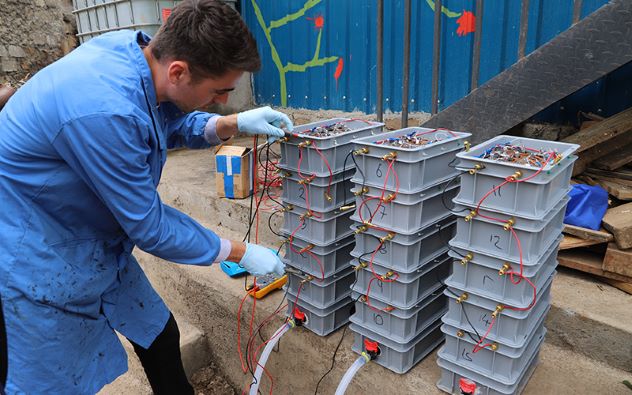 Now Urine can be used to power your electronics
In the foul-smelling areas that we encounter in our day to day lives, often lie open sewers or sewage treatment plants. While we loathe these structures, the growing density of our cities and the general urbanization rate have made them indispensable for our water and some of our electricity needs.
Robial, a company from UK is offering one such option that could help solve this stench ridden problem. The social enterprise at the University of West England (UWE), is attempting to commercialise ‘Pee Power’, which uses microbial fuel cells that feed off organic carbon found in urine and wastewater to produce electricity.
Robial which was founded only in November 2018 wants to commercialize the concept that has been in the works for a long time and could be revolutionary, having advantages in both renewable energy generation and the recycling of wastewater.
Funded by the Bill and Melinda Gates Foundation, the UK Engineering and Physical Sciences Research Council (EPSRC) and the European Commission, Professor Ioannis Ieropoulos, director of the Bristol BioEnergy Centre at UWE and creator of the Pee Power technology, developed microbial fuel cells as part of his PhD project 17 years ago. After years of perfecting the technique, now the technology is being readied for commercialization and has been trialed successfully in African refugee camps, as well as at Glastonbury Festival in the UK. It has been used to provide lighting for toilet blocks at schools in Uganda and Kenya.
