Amazon Signs $30 Million Deal for Carbon Credits from Indian Rice Farmers
- Amazon has entered into a $30 million agreement to purchase carbon credits generated by Indian rice farmers, centred on a cultivation method known as Alternate Wetting and Drying (AWD).
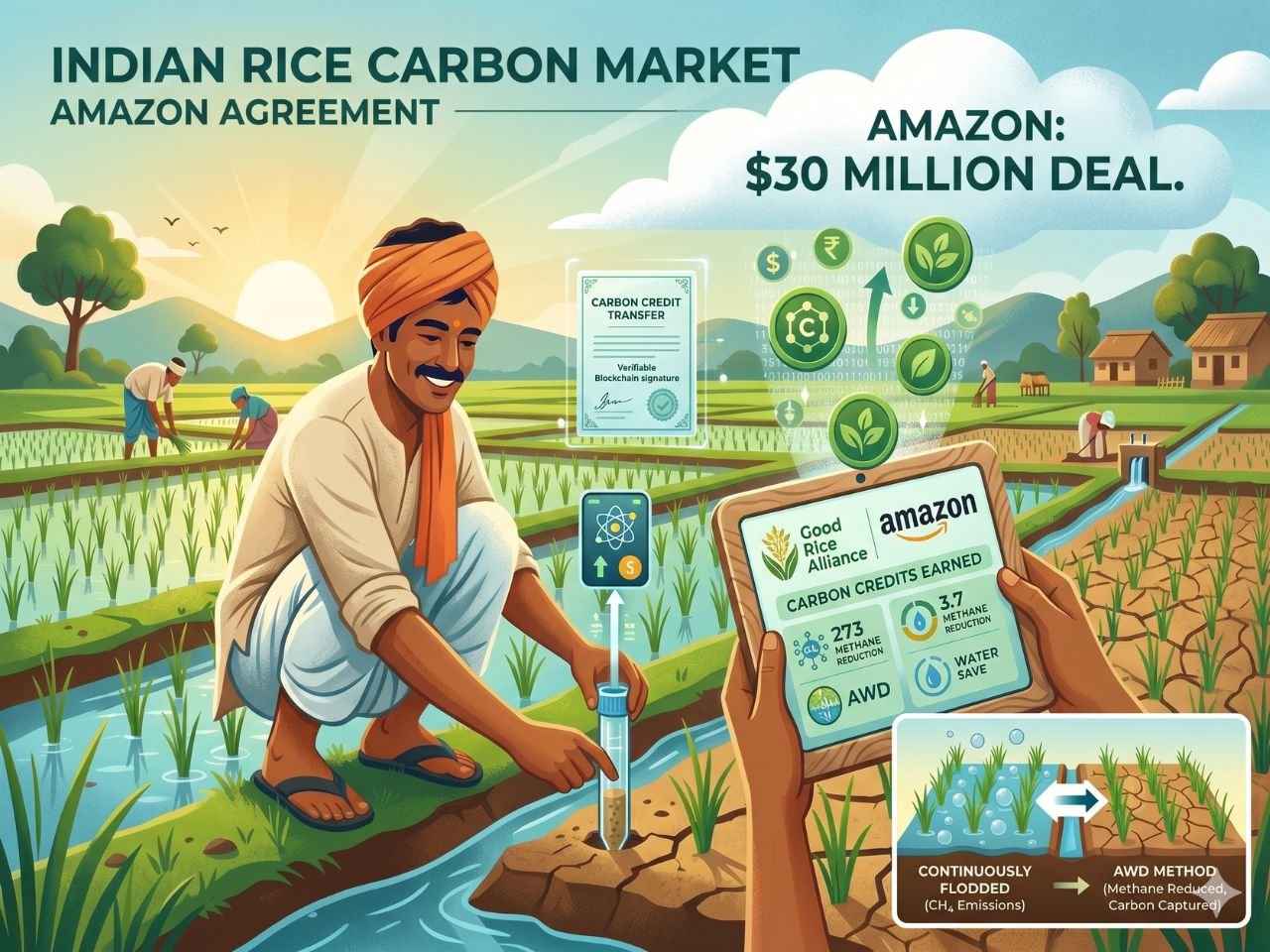
Amazon has entered into a $30 million agreement to purchase carbon credits generated by Indian rice farmers, marking one of the country’s largest agriculture-linked carbon deals and highlighting a shift in corporate climate strategies.
The agreement is being implemented through the Good Rice Alliance, a collaboration involving Bayer, GenZero, and Shell Nature-Based Solutions, with backing from Singapore’s Temasek. Instead of engaging directly with individual farmers, Amazon is leveraging the alliance’s network to scale the programme efficiently across multiple regions.
Farming Practice at the Core
The initiative centres on a cultivation method known as Alternate Wetting and Drying (AWD). Traditionally, rice paddies are kept continuously flooded, creating low-oxygen conditions that generate methane emissions. Under AWD, fields are periodically drained, reducing methane formation while maintaining crop productivity.
Beyond lowering emissions, the method significantly reduces water consumption, an important benefit in water-stressed regions. Farmers adopting these practices also gain access to an additional income stream by earning carbon credits, which can be sold to corporates such as Amazon. This model effectively links sustainable agriculture with financial incentives.
Project Scale and Impact
The current phase of the initiative spans more than 13,000 smallholder farmers across approximately 35,000 hectares. Amazon expects the programme to offset around 685,000 metric tonnes of carbon dioxide equivalent emissions, contributing to its broader climate goals.
The deal underscores a growing corporate focus on agriculture-based carbon solutions. While earlier carbon offset strategies largely centred on forestry and renewable energy, this initiative targets methane emissions directly—an area gaining increasing attention due to its high global warming potential.
Implications for India
For India, the development carries significant implications, the official statement notes. As the world’s largest rice producer and a major source of methane emissions, scaling such initiatives could support national climate targets while enhancing rural incomes. The integration of smallholder farmers into global carbon markets also reflects the evolving sophistication of climate finance mechanisms.